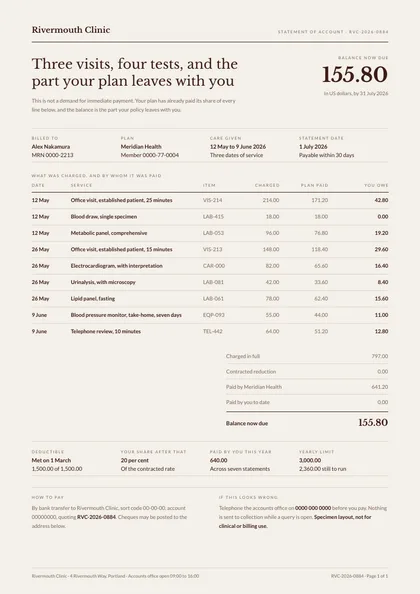
Minimal, type-led · Oxide & teal · Libre Baskerville + Lato
refined A4 portrait 1 page
See the full document
Use this template
Healthcare
A medical bill is read for one number and then checked line by line. These layouts show what was charged, what the plan paid and what is left, in that order, so the balance can be verified rather than taken on trust. Sample data is fictional; item codes are a clinic's own and belong to no published scheme.
3 designs, each a separate take on the same document rather than a recolour of one layout: Minimal, type-led, Band header and Framed ceremonial. Every preview below is the actual compiled output, not a mock-up.
Open one in the editor and render it from your own JSON over the API — 1 page of A4 portrait, the same engine either way.
Minimal, type-led · Oxide & teal · Libre Baskerville + Lato
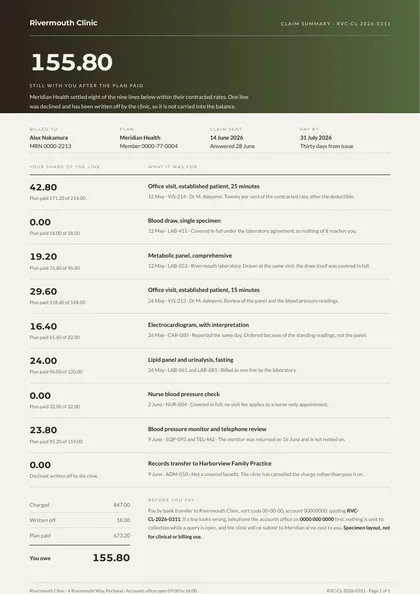
Band header · Espresso & sage · Montserrat + Lato
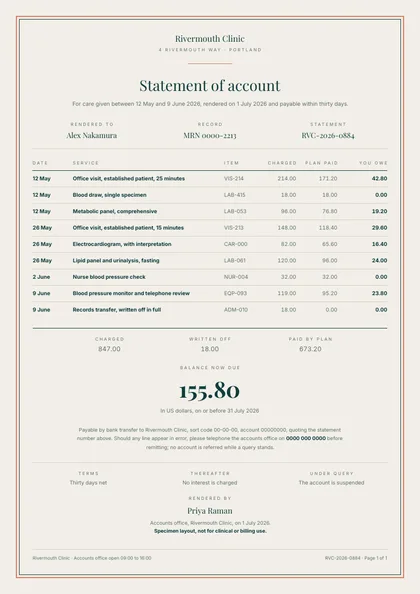
Framed ceremonial · Teal & coral · Playfair Display + Inter
Same document, same data model, 3 different arguments about how it should look on paper. Pick on layout and typography — the content behaves identically.
| Design | Layout | Palette | Typefaces | Pages |
|---|---|---|---|---|
| Care Ledger | Minimal, type-led | Oxide & teal | Libre Baskerville + Lato | 1 · A4 portrait |
| Claim Margin | Band header | Espresso & sage | Montserrat + Lato | 1 · A4 portrait |
| Statement Formal | Framed ceremonial | Teal & coral | Playfair Display + Inter | 1 · A4 portrait |
Each design is authored against an explicit reflow contract, so it is defined up front which blocks are emitted once per record and which fields absorb longer content. That is what stops the layout falling apart at a hundred rows.
| Design | Repeats per record | Grows with your data |
|---|---|---|
| Care Ledger | the charge rows; the totals lines | any service description that wraps; the payment note |
| Claim Margin | the claim lines, each hung off the same margin | any service description that wraps; the closing note |
| Statement Formal | the charge rows | any service description that wraps; the closing note |
These document sets each include the medical invoice designs above.
Open a design in the editor and the agent reshapes it around your schema — then render it from your own data over the API, or let your users edit it in the embedded editor.